

 Markdown Monster
Posts related to: ASP.NET
Getting Inherited Controller Routes to work in ASP.NET Core

Controller inheritance in ASP.NET Core is an edge case, but if you need it you have to be mindful of how route inheritance works in ASP.NET. This post explores why concrete class inheritance causes route duplication and provides a couple of solutions.
Lost ASP.NET Identity Cookies on IIS Application Pool Restarts

If you find that your ASP.NET authentication cookies expire every time your IIS application pool restarts or recycles, the culprit is likely the DataProtection API not finding the previously stored keys. This post describes one gotcha I ran into with the default storage location on IIS in the user profile due to a default Application Pool setting.
Running ASP.NET Core Applications as a Subfolder Application
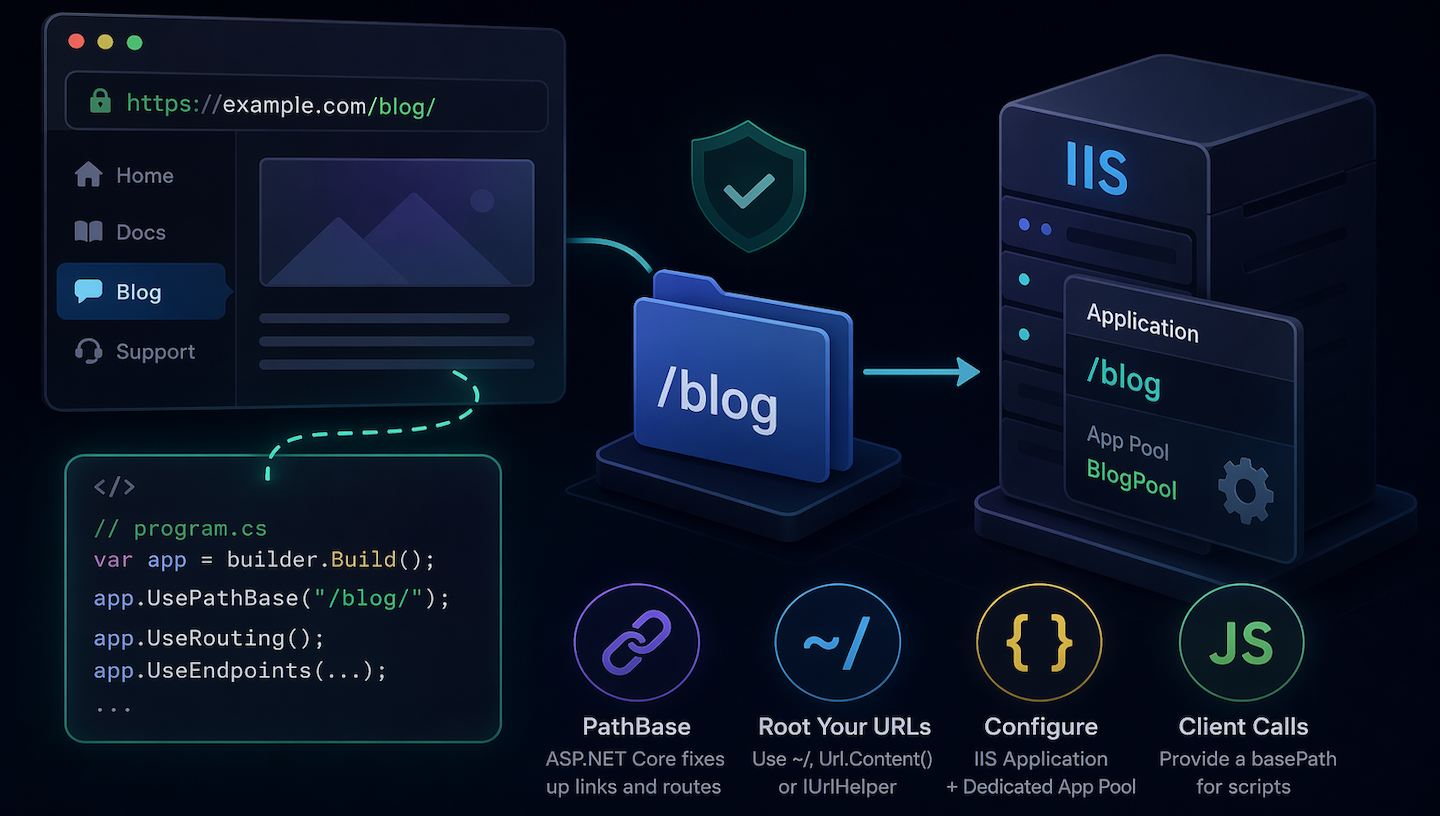
While ASP.NET Core applications typically run from the root folder, some scenarios—such as hosting multiple blogs under a single domain—require running from a subfolder. This post explains how to configure ASP.NET Core with app.UsePathBase() for proper routing and ~/ path resolution, along with the IIS setup required for a dedicated Application Pool using "No Managed Code." It also covers key migration tips, including bulk updates for root-relative links and JavaScript adjustments to keep client-side functionality working in a subfolder environment.
Getting the Client IP Address in ASP.NET Core

When I need to pick up the client IP Address in ASP.NET Core I always forget where to find the connection information and/or forget about picking proxy forwarding instead of the actual IP address. To make things easy and reusable, here's a small HttpRequest extension method.
Adding Runtime NuGet Package Loading to an Application

It's not a common use case, but if you need need to dynamically add external code at runtime, NuGet packages are the most familiar way for developers to add that functionality besides old-school direct assembly loading. In this post I look at my LiveReloadServer local Web Server tool and how I integrated both external assembly loading and NuGet package support to allow extensibility for the Razor (and Markdown) scripting functionality of LiveReloadServer.
Resolving Paths To Server Relative Paths in .NET Code

ASP.NET Core has support for resolving Urls in Controllers and Razor Pages via embedded `~/` links in Views and via `Url.Content()`. But, these features are tied to Controllers or Razor Pages - what if you need to resolve Urls elsewhere, in middleware or even inside of business logic? In this post I describe how you can build a couple of helpers that are more flexible and also provide some additional functionality of resolving site root and relative paths to full site root paths.
Inline Confirmations in JavaScript UI

Confirmation dialogs or modal popups can be annoying in HTML applications. What if you could instead use an inline UI to confirm an operation? In this post I describe a simple way you can use an inline UI to confirm an operation that can be easily implemented with a few lines of code and a couple of binding directives.
Comparing Raw ASP.NET Request Throughput across Versions: 8.0 to 9.0 Edition

Once again I'm taking a look at the newish .NET release and how it compares to the previous release - this time .NET 9.0 from .NET 8.0. I'll run my simple load tests to compare performance and also discuss a number of anecdotes from running .NET 9.0 in production apps for the last couple of months.
Getting the ASP.NET Core Server Hosting Urls at Startup and in Requests
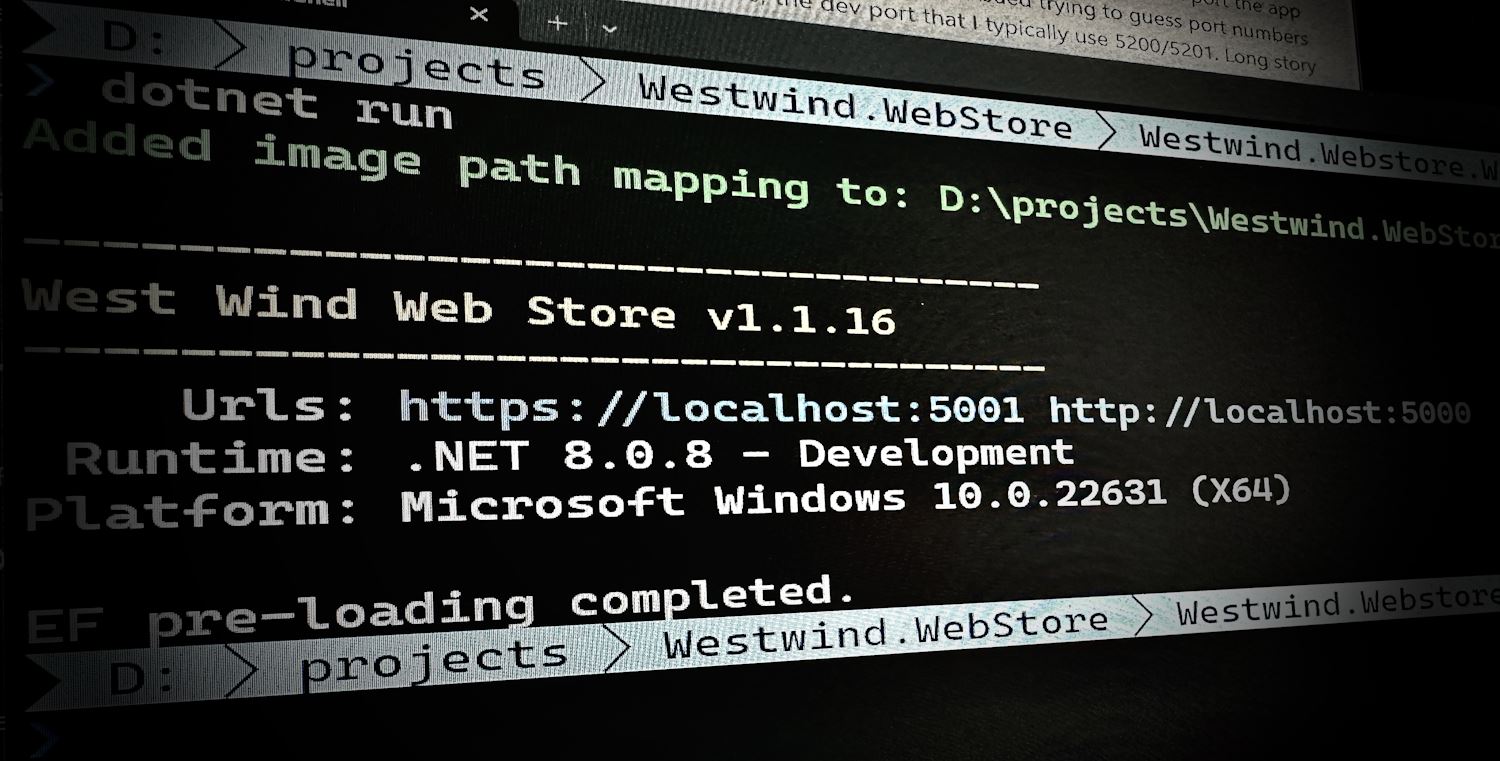
Ever need to retrieve an ASP.NET application's hosting Urls? There are million ways to set these URLs but there's no easy fixed location where you can pick the addresses up from. Instead you have to go through a bit of a dance, and use one of two approaches depending on whether you need the addresses during startup or inside of a request.
ASP.NET Core Hosting Module with Shadow Copy Not Starting: Separate your Shadow Copy Folders!

I recently ran into a major failure related to Shadow Copying for an ASP.NET Web app on IIS which was caused by corruption of the Shadow Copy directories. The app starts with the dreaded white ANCM Error page and event log entries that point at missing application folders. It turns out that this is caused by interference of multiple applications using the same shadow copy folder. In this post I describe the problem and how to work around it.
Programmatic Html to PDF Generation using the WebView2 Control with .NET

In this post I describe how to use the Microsoft WebView2 control to automate HTML to PDF generation generically for any kind of Windows application, including services. We'll look at the WebView and it's printing functionality and some of the intricacies that are involved in hosting the WebView control outside of a desktop application context to provide unattended mode even in service context.
Comparing Raw ASP.NET Request Throughput across Versions

When I set up a new machine I usually use a small ASP.NET test project to get a feel of performance of the machine and when that happens I also take a moment to compare performance across recent versions of .NET to see how things are improving - and improved they have. Both due to the new hardware I'm using but also ASP.NET continues to bump up performance in every new version that comes out. In this post I describe a simple project with minimal do nothing requests to test the ASP,.NET pipeline locally and how to test these request as well as discussing the results.
Reading Raw ASP.NET Request.Body Multiple Times

Some time ago I wrote about accessing raw request body content in ASP.NET Core which ended up being one of the most popular posts on this blog. But I failed to mention one major caveat: By default Request.Body can only be read once. In this post I discuss why frequently when you need raw Request.Body access you actually need to read the body more than once, and you can enable that functionality and deal with the caveats of doing so.
Embedding a minimal ASP.NET Web Server into a Desktop Application

Did you ever need to embed a Web Server into a non-Web application? In this post I describe how you can use host ASP.NET in a non-Web application and specifically in a WPF desktop app. What do you need, how is it different and some of the issues that you need to consider if you want to use ASP.NET in your non-Web applications.
IIS Error 500.19 with ASP.NET Core Application
Running on IIS locally is pretty rare, but if for some odd reason you decide to run IIS locally on your dev machine you might find yourself getting a 500.19 error which relates to an issue in the web.config configuration. The solution is simple enough: Make sure the ASP.NET Core Hosting Module is installed. In this post I describe in more detail what the problem is and why you need a seemingly superfluous extra install to get IIS and ASP.NET Core to cooperate on local dev machine.